

Your Master’s degree in Engineering – Study flexibly with Online Face-to-Face-Classes
Degree: Master of Science (M.Sc.) in Engineering
You can choose from the following specialisations:
- Industry 4.0
- Mechatronics
- Automotive Engineering
- Environmental Engineering
Registration deadline: 10.10.2026 | Programme start: 15.11.2026
- Master’s degree in just 1.5 years
- Study flexibly alongside your job – with Live-Online-Classes
- Career advancement and higher salary
- Renowned lectures from the industry
- Practical expert knowledge
- Advanced Programme: Doctor of Philosophy (Ph.D.)
Are you aiming for a higher academic qualification in engineering? Would you like to expand your career opportunities at management level and take on responsibility in your area?
Then our Engineering Master’s degree (M.Sc.) is just right for you. You will learn to understand and apply complex technical concepts. Your multidimensional degree also includes exciting cross-functional disciplines such as electrical engineering, automation and artificial intelligence. This is how you can expand your professional skills in all areas that will be crucial for your future career.
As an expert in future topics such as Industry 4.0, environmental technology, automotive or mechatronics, you will sharpen your professional profile! This will create the perfect conditions for your career as a technical expert or in senior management.
Thanks to our virtual face-to-face studies – with e-learning, digital live lectures and webinars led by dedicated instructors – you will learn in a self-determined, flexible and efficient way.
Content
Overview
| Degree: | Master of Science (M.Sc.) in Engineering EQF/MQF Level 7 |
| Duration of study: | 3 Semester (1.5 years) |
| European Credit Transfer: | 90 ECTS points |
| Study model: | Full-time – can be combined with profession regardless of location |
| Study concept: | Online face-to-face teaching with live online lectures |
| Virtual classroom studies: | Online studies with e-learning and live webinars via our learning platform |
| Language of Instruction: | English |
| Specializations: |
|
| Independence of location: | Study digitally and live worldwide – from home, at work or on the go |
| Seal of quality: | Accredited by the MFHEA (Malta Further and Higher Education Authority) |
| Tuition fees: | 7,890 € instead of 9,960 € |
| Further programme: | Doctor of Philosophy (Ph.D.) |
What can I expect from the Master in Engineering?
In your programme of study, you will acquire in-depth knowledge in the field of engineering. In addition, you will acquire a critical understanding of theories and principles that are taught as part of the Engineering degree programme.
Your learning content at a glance:
- Expertise in relevant engineering disciplines
- Advanced Engineering Fields of Study
- Current topics such as renewable energies, energy storage and electric mobility
- Effects of the external environment (national and international) in the context of technology
- Analysis of current engineering issues and their solutions
In addition, you will further develop your personal skills during your studies. These include, for example, soft skills such as independent learning, problem-solving and decision-making, and your teamwork skills. We also strengthen you in the areas of self-awareness, presentation and self-management.
We support you in using your skills for your career planning!
Expert opinion

| “Triagon’s practice-oriented master’s programme provides students with sound skills in the field of application-oriented engineering. Specializations can deepen areas of interest – and open up career opportunities. Our master’s graduates become sought-after experts at the interface between technology and business. They learn to actively and sustainably shape the future as leaders.” | |
| Prof. Dr. Dirk Matten Dr. Ing., Dipl. Informatik |
|
Expert opinion
| “Triagon’s practice-oriented master’s programme provides students with sound skills in the field of application-oriented engineering. Specializations can deepen areas of interest – and open up career opportunities. Our master’s graduates become sought-after experts at the interface between technology and business. They learn to actively and sustainably shape the future as leaders.” |
| Prof. Dr. Dirk Matten Dr. Ing., Dipl. Informatik |
Recognition and Accreditation of the Study Programme
Triagon is a Higher Education Institution with international accreditation. Our institution meets the European Standards and Guidelines (ESG).
This has been confirmed by the distinguished German accreditation agency ACQUIN, which is a full member of EQAR. The institutional accreditation was granted in full and without conditions.
In addition, all degree programmes are accredited by the Malta Further and Higher Education Authority (MFHEA), at levels 6 (Bachelor), 7 (Master) and 8 (Doctorate) of the Malta Qualifications Framework (MQF) and the European Qualifications Framework for Lifelong Learning (EQF) respectively.
All Triagon study degrees comply with the Bologna Reform and can be internationally recognized. In most European countries, such as Germany, France and Great Britain, individual companies, authorities, and universities decide on the recognition of foreign university degrees. You can find more information here: Recognition & Accreditation.


Virtual face-to-face attendance at TRAIGON: A flexible combination of distance learning and personal interaction with dedicated instructors
Our digital study concept combines flexible e-learning with live online lectures. Instead of pre-recorded videos, you’ll learn from real lecturers who answer your questions and support you every step of the way until you successfully complete your degree.
During your studies, you can expect::
- Online learning platform for your self-study
- Exchange with fellow students
- Digital live lectures: normally once a week in the evening and twice a month on the weekend
- Extensive online library
- Case-based learning
- Independent project assignments
- Eigene Projektarbeiten
- Practical, industry-focused education
Combine your Master’s degree in Engineering with your career and family life – with complete flexibility to fit your schedule!
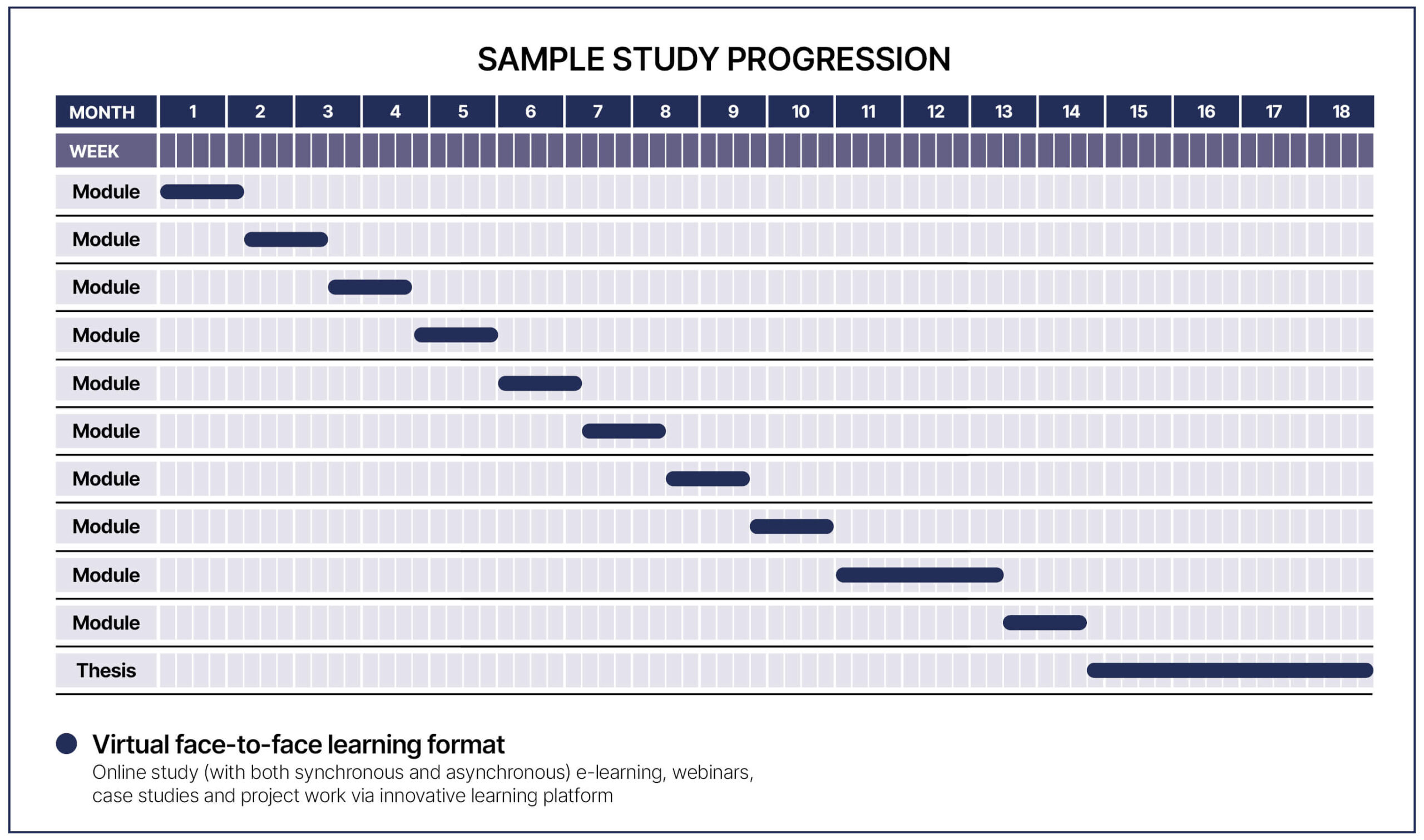
Features of our digital learning concept:
- Study flexibly alongside your job:
The flexibility of the virtual classroom study enables you to study alongside your job, including the transfer of knowledge into practice. - Online studies with personal support:
At Triagon, you study in our Online Face-to-Face format. This combines the location independence of distance learning with the benefits of personally supervised online studies (interactive live lectures and professional exchange with lecturers and fellow students). - Multimedia documents for all types of learners:
The multimedia learning materials on our learning platform (video lectures, online tutorials, online tests, PDF guidelines) enable you to learn efficiently. All types of learners can benefit. - Better learning progress by studying in the block model:
You complete one module after another. This way, you can always concentrate on a single topic. And if you happen to miss completing a module, you can make it up the next time around. Your studies won’t be disrupted. You simply move on to the next module. - Case study-based learning for increased action competence:
Our approach to project-based learning is characterized by a pronounced practical orientation of the course content. We offer you the opportunity to combine study and project work with your profession in terms of subject matter and time.
Course of study: Master’s programme in Engineering
Your Master’s degree comprises eleven modules, which you will complete one after the other and conclude with your Master’s thesis. The programme compromises 90 ECTS credits and is typically completed in three semesters. You can also take more time to complete it.
You will be taught the following skills, among others:
- Assessment of real engineering scenarios
- Analysis and interpretation of advanced technical challenges
- Performance of advanced engineering-specific analyses
- Handling of complex data
- Organization and implementation of an individual research project
- Use of IT and specialist software programs
- Reflection on social and ethical responsibility (application of one’s own knowledge)
Your modules in the Master’s programme in Engineering
Module 1: Advanced Machine Elements
This course covers the calculation and design of gears, shafts, bearings, gearbox housings, couplings, chains, and belts (referred to as “elements”). You will gain advanced knowledge of how machines operate and be introduced to the core principles governing these elements, enabling you to select the appropriate type of element for any given application.
Assessment: Group Work (100%)
Module 2: Advanced Electronics
In this module, your existing knowledge of electronics is combined with new technologies and aspects of technical application and reporting. The course covers fundamental methods and principles within the context of standards and practices, modeling, analysis, design, and practical implementation.
Electronic systems covered:
- PLLs
- Oscillators
- Analog-to-digital conversion
- Power conversion and control
- IC-Design
- Radio-frequency circuits and systems
- RF measurements
- CAD
Assessment: Group Work (100%)
Module 3: Advanced Automation
The aim of this module is to provide you with advanced core competencies in plant engineering. The course offers insights into the latest aspects across various areas of the field – for example, covering the role of the digital twin in design, maintenance, and simulation.
Topics covered:
- Plant operation
- Building Management
- Measurement and Control Technology
- Electrical Engineering
- Environmental technology
- Security and Financial Management
Assessment: Group Work (100%)
Module 4: Renewable Energy
For a sustainable future, fossil fuels must be replaced by renewable energy sources such as wind and solar energy or biomass fuels. This module introduces you to topics regarding energy sustainability, climate change, and renewable energy technologies.
Your learning content:
- You understand the connection between energy use and sustainability.
- You know how current energy use contributes to global climate change.
- You know the difference between renewable and non-renewable energy sources.
- You are familiar with various forms of renewable energy.
- You are familiar with the advantages and disadvantages of various renewable energy sources.
Assessment: Research Paper (100%)
Module 5: Advanced Mechatronics
This course offers you an in-depth insight into the design of mechatronic systems.
Topics covered:
- Low-level interfaces between software and hardware
- High-level programming tools for implementing real-time computational tasks
- Digital logic
- Analog Interfaces & Power Amplifiers
- Measurement & Sensor Technology
- Electromagnetic and optical transducers
- Control of Mechatronic Systems
Assessment: Learning Portfolio with Presentation
Module 6-8: Specialisation modules
In modules six through eight, you have the opportunity to specialize within your engineering degree program. You can choose from the following specializations: Industry 4.0, Environmental Technology, Automotive, and Mechatronics. You take three modules for each specialization.
Automotive Engineering
- Module 6: Lightweight Construction
- Module 7: Electrification of the Driveline
- Module 8: Trends & Strategies in Automotive Construction
Industry 4.0
- Module 6: Networking & Digitalisation
- Module 7: Reference Architecture Industry 4.0
- Module 8: Best Practice on the Basis of Selected References
Mechatronics
- Module 6: System & High-voltage Technology
- Module 7: Assistance Systems & Autonomous Driving
- Module 8: Artificial Intelligence in Control Engineering of Component
Environmental technology
- Module 6: Demand Oriented Energy Mix
- Module 7: Energy Storage
- Module 8: Smart Energy Consumption
Modul 9: Internship
As part of this module, you can put your theoretical skills into practice. To this end, you will work in the fields of application of engineering. The activity is designed as a well-founded reflection internship and can be completed as part of your professional work or when starting a business, but also as vocational training, an internship, or through volunteer service.
Modul 10: Advanced Research Methods
In this module, you independently design and conduct an empirical study in a field of engineering. This gives you the opportunity to apply the research skills you have developed.
Deine Lerninhalte
- You deepen your understanding of the complexity involved in conducting empirical research
- You will learn to work on scientific research topics
- You strengthen your quantitative or qualitative research skills
- You improve your communication skills
- You strengthen your ability to evaluate critically
Assessment: Project Paper (100%)
Modul 11: Masterthesis
Um Deinen Master in Engineering abzuschließen, verfasst Du am Ende Deines Studiums Deine Masterthesis. Hierbei führst Du ein Forschungsprojekt Deiner Wahl durch. Das Thema Deiner Abschlussarbeit kann praktischer, theoretischer, technischer oder historischer Natur sein. Dein Abschlussprojekt sollte vorzugsweise mit Deiner gewählten Studien-Spezialisierung verknüpft sein.
Selbstverständlich wirst Du während des gesamten Prozesses Deiner Ausarbeitung fachlich und individuell betreut.
Assessment: Dissertation (80%), Presentation (20%)
You can request more details about the entire program here:
Course handbook
info@triagon.mt
Your learning content
- Assessment of real engineering scenarios
- Analysis and interpretation of advanced technical challenges
- Performance of advanced engineering-specific analyses
- Handling of complex data
- Organization and implementation of an individual research project
- Use of IT and specialist software programmes
- Reflection on social and ethical responsibility (application of one’s own knowledge)
Your studies at TRIAGON
The engineering master’s programme is based on our digital study concept Online Face-to-Face. You combine the best of two worlds: flexible distance learning plus live online lectures, with which our dedicated lecturers support you until successful completion. This way, you can design your studies to fit your professional career and work location-independently.
Study globally digital and live – from home, at the workplace, or on the go!
Target group and personal requirements
Our Master of Science in Engineering is primarily aimed at experienced professionals with a bachelor’s degree in mechanical engineering or electrical engineering, or with a comparable professional qualification at EQF/MQF Level 6, such as industrial/craft master, state-certified technician, or similar. However, you can also start directly after completing a bachelor’s degree.
Qualities helpful for the programme are:
- Identification with responsible activities
- Openness and willingness to learn through self-reflection, analysis, feedback, supervision
- Team and communication abilities
- Organisational talent and leadership skills
- Good knowledge of English
- Determination
- Enthusiasm for technology
- Analytical and conceptual skills
- Profound interest in science
- Good self- and time management for the phases of your self-study
- Study digitally and live from anywhere in the world—from home, at work, or on the go
Your Online-Face-to-Face-studies at TRIAGON – as flexibel as your life
In developing our study program, we have taken into account that life circumstances change over time. That’s why with the Master in Project Studies we offer you the opportunity to adapt your studies to your life.
Despite changes in your life circumstances, you can continue your studies at Triagon. We have taken many things into consideration:
- Studying in middle age (Link: https://www.triagon.mt/learning-concept/advantages-and-opportunities/study-from-30-years/)
- Studying with a child (Link: https://www.triagon.mt/learning-concept/advantages-and-opportunities/studying-with-a-child/)
- Studying without barriers (Link: https://www.triagon.mt/learning-concept/advantages-and-opportunities/learning-with-disability/)
Career Fields for Graduates of the Master’s Programme in Engineering
Where do you work as a Master’s of Science in Engineering?
The range of activities for our graduates is unlimited. We need technical innovations in all industries and areas of life. Digitalisation is everywhere and is driving technological advancement, automation, and electrification even further. With your specialist knowledge, a career in environmental engineering, mechatronics, or the automotive sector offers excellent prospects for success.
In addition, your Master’s degree in Engineering qualifies you to take on responsibility in higher management positions.
What tasks do you take on as a Master of Science in Engineering?
Depending on the industry, holders of a Master’s degree in Engineering perform a variety of tasks, all of which are highly specialized. Among the most important professional responsibilities are:
- Planning, controlling and optimizing technical processes e.g., production planning
- Research and development, implementation of strategic projects and products
- Implementation of optimization measures
- Produktionsplanung
- Quality assurance
What are the future opportunities as a Master of Science in Engineering?
Engineers with a master’s degree can rely on a secure future: The academic qualification of a master’s degree makes your career in a management position possible – and there is also a wide range of exciting positions to choose from!
Your salary prospects with a Master’s degree in Engineering
According to Indeed, with a master’s degree in engineering you can earn an annual salary of around 55,000 – 70,000 euros. Depending on the region, industry, education, and professional experience, the salary will of course vary. Especially in management positions, the salary range is open to the top.
Entry requirements
Admission to the Master’s programme in Engineering is based on the Maltese principle that professional and academic qualifications are considered equally valuable. This means that qualifications such as a Master Craftsperson, Specialist Diploma, Advanced Technical Diploma, or comparable professional qualifications at MQF/EQF Level 6 qualify applicants for admission just as much a university bachelor’s degree does.
The admission criteria, as specified by the accreditation, are as follows:
Prospective students must be in possession of:
An MQF/EQF level 6 in the following qualifications obtained from a recognised college/Institute/University:
- Mechanical
- Electrical Engineering
Or
An MQF/EQF level 6 in the following qualifications obtained from a recognized college/Institute/University:
- Industrial Electronics
- Electrical Systems
- Vehicle Engineering
- Manufacturing
- Marine Engineering
- Operations and Maintenance
For those students whom degree was issued from a non-English instruction university, they must produce evidence of English language proficiency at IELTS:6.0 or equivalents with a minimum of 5 in each component, i.e. Speaking, Listening, Reading and Writing or English B2 referred to CEFR. The students with a low IELTS score will get additional support that also includes a free course in English and additional resources as well as individual tutoring
For you, this means::
- Studying without an admission quota (Numerus clausus)
- Studying on the basis of a bachelor’s degree, but also with a vocational qualification at Level 6 of the EQF/MQF
- A degree in mechanical engineering, mechatronics, electrical engineering or similar
- Good knowledge in English
Feel free to contact us by e-mail: info@triagon.mt