
Strategy
Triagon was founded in Malta in 2018 to open higher education to people it had not served well: experienced adults, most of them in full-time work, whose professional learning deserved to count towards a qualification. That purpose has not changed. Today we teach more than seven hundred and fifty students across sixteen countries, entirely online, and the average student who joins us is thirty-seven years old.
A strategy is how an institution decides what to do next, and what not to do. Ours sets the direction for teaching and learning, for the programmes we offer, for research, for how we work with partners abroad, and for the kind of institution we intend to be by the end of the period. It is approved by our Senate and overseen by our Board of Trustees, and it is turned into an annual operational plan with named responsibilities, deadlines and measures, so that progress can be checked rather than assumed.
We are publishing the process as well as the outcome. The sections below set out who develops the strategy, how it is governed, when each stage happens, and the values it rests on. They also set out how to take part. Strategies written behind closed doors tend to describe institutions that no longer exist; we would rather hear from the people who study here, teach here, and work with us while the decisions are still open.
Strategy Development Group.
The Strategy Development Group brings together the people responsible for shaping Triagon’s next strategic period. It is convened by the President and draws on academic leadership, administration, quality assurance student representation and a stakeholder representative. Its task is to gather the evidence, test it against what students, staff and partners tell us, and prepare a draft for the Senate. The Group does not decide the strategy. It prepares it, documents the reasoning behind each proposal, and puts the alternatives to the bodies that hold the decision.
A summary of Triagon’s strategy can be accessed here – Strategy 2026-2028
Governance and oversight.
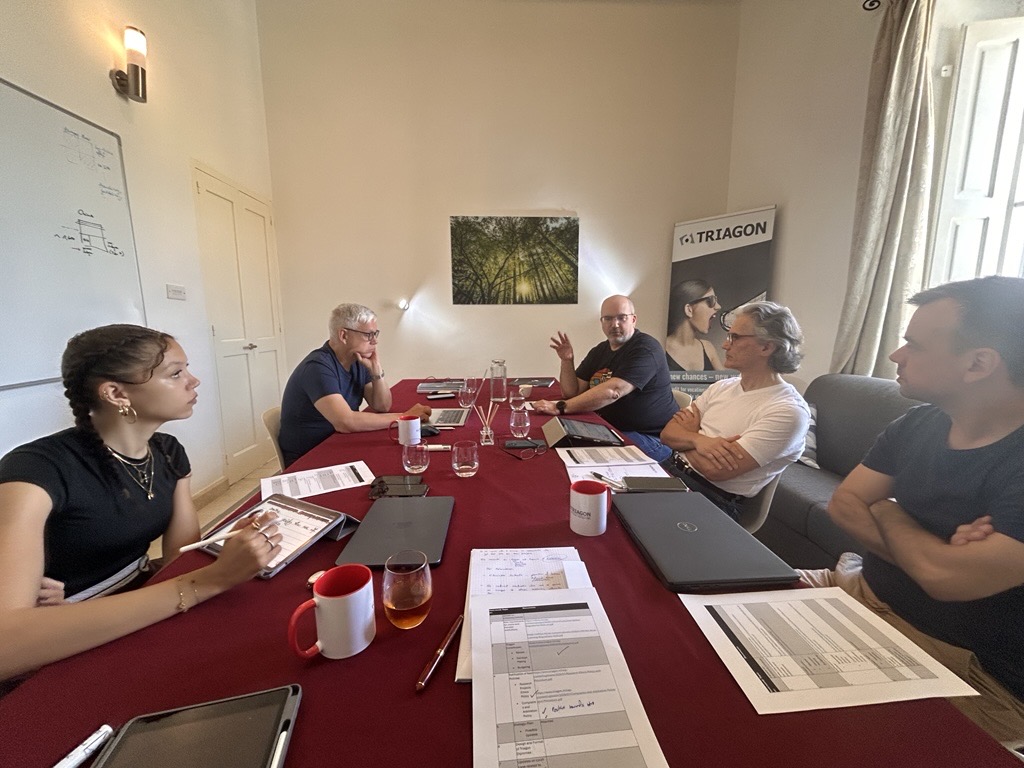
Responsibility for the strategy is clearly divided. The Senate is the main academic governing body and approves the strategy and the plans that follow from it. The President is responsible for Triagon’s strategic orientation and positioning and chairs the Senate. The Board of Trustees oversees the strategic direction, monitors progress against it and provides advice and support. Day-to-day implementation rests with the Executive Dean and the Director of Administration. Progress is reported through the Planning, Monitoring and Review Procedure, which sets out who is accountable at each stage of the cycle and how performance is brought back to the Senate.
Timeline for strategy development.
The strategy is developed in four phases. The first gathers evidence: performance against the current indicators, evaluation and survey results, and the external environment in which we operate. The second opens the conversation through the Triagon 2028 Dialogue and the strategy surveys. The third converts what we have heard into draft priorities, published as briefs for comment. The fourth takes the draft through the Internal Quality Assurance Board and the Senate for approval, after which the strategy is published together with the operational plan that puts it into effect.
Our values.
Triagon was founded to create new educational pathways and qualification opportunities for people whom conventional higher education does not serve well. That purpose still holds, and the values that follow from it are these: access, because professional experience and prior learning are recognised alongside formal qualifications; student-centredness, because our students are adults balancing study with work and family; applied relevance, because what is learned should be usable; academic freedom and integrity, without which a qualification means nothing; equality and inclusion, in admission, in teaching and in assessment; and continuous improvement, because we would rather find a weakness ourselves than have it found for us.
The Triagon 2028 Dialogue.
The Dialogue is the open conversation that runs alongside the formal strategy work. It is a series of online sessions in which students, academic and administrative staff, alumni, partner institutions and employers are invited to discuss what Triagon should become by 2028. Because we teach online and our community is spread across sixteen countries, the Dialogue is held online too, at times chosen to suit people who study and work. Sessions are structured around the draft priorities but are not limited to them. What is said is formally and informally noted, summarised and published through the strategy objectives, so that participants can see how their contribution was used. In addition, Triagon provides a running consultation, and anyone can provide ideas and feedback through stakeholder.consultation@triagon.mt .
What matters?
Every strategy risks being written by the people who already hold the pen. “What matters?” is the part of the process designed to prevent that. It is a single open question put to everyone connected with Triagon: what matters most to you about your studies, your work, or your relationship with us, and what would you change? There is no template and no word limit. Responses can be submitted at any point during the development period, anonymously, through stakeholder.consultation@triagon.mt if preferred. They are read in full, grouped into themes, and reported to the Strategy Development Group alongside other information.
Strategic priority briefs.
Each candidate priority is set out in a short brief of two or three pages. A brief states what the priority is, why it is proposed, what evidence supports it, what it would cost in effort and resource, what would have to be given up to pursue it, and how we would know whether it had succeeded. The briefs are published for comment before the strategy is finalised. Publishing them separately allows each priority to be argued on its own merits, and allows anyone who disagrees to say so while the decision is still open.
Strategy surveys.
The strategy surveys are made of of multiple questionnaires which are sent out to diofferent stakeholders throughout the year and ask specific questions of specific groups: current students, alumni, academic staff, administrative staff, and our partner institutions. They are distinct from the module and service evaluations that run every semester, and from the alumni tracer study, though the findings of all of these feed the same process. The surveys are short, anonymous and open for a defined period. Results are published in aggregate, including the response rates, so that readers can judge for themselves how much weight the findings carry.